Below I have created three presentations that show the research/planning, production and post-production for my groups music video, album and website. Music Video Presentation: I will look into how different technologies have helped us represent our artist, create her star image and connect with our target audience.
Digi-pack Presentation Here's a slide show of how technology was used to create our digipak, but also how technology helped us represent our artist:
We used the following technology through the design and production of our website: Research/Planning:
Artist Websites - Google Search Engine - We looked up artists' websites in the same genre.
Social Media Trends (Facebook, Twitter, Instagram etc...) - We looked up at how artists in the same genre remain connected to their audiences online.
Production:
Photoshoot - We carried out a photoshoot for our artist.
Cannon 1100D - To take photographs
Adobe Photoshop - To edit the photographs for the website
Macbook Pro with Retina Display - The laptop that we transferred the images to and edited the photos on
Post production:
Wix website builder - Website building software that we used to build the website.
Social Media Account (Facebook, Twitter and Instagram) - created profiles for our artist in order to engage with audience and advertise themselves on, we linked these social media accounts to the website.
Bellow is a sound cloud where I explain not just what we used in terms of technology but how we used the technology to create the star image and representation. Along with how technology has helped us reach our target audience.
Below is my Evaluation Task 3 where I discuss the audience feedback I received and what I learned from it. In my Prezi I will walkthrough the entire process of pitching ideas and the feedback I received that influenced the final product.
Below is the first pitch of our music video to 'Are You That Somebody' that we developed as a group:
We then created a rough cut of our music video, digipak designs and website which we showed to various focus groups. We then asked them on feedback. I will look into how we gathered the feedback and how it helped us overall. Below is the rough cut that we showed to the focus group: Rough Cut:
Digipak Draft:
Website:
We gathered our audience feedback by conducting focus groups and collecting qualitative and quantitative data through questionnaires from our focus groups. For the feedback for our music video and digipak, we conducted a large focus group consisting of our target audience. The feedback from our focus groups was recorded so that we could go back and analyse their comments later on.
These are the videos of the focus groups:
We also created a questionnaire that asked varied qualitative and quantitative data; for example quantitative data included: ‘How old are you?’; while qualitative questions included: ‘What changes would you make to the music video?’.
Below are some of the quantitative and qualitative questions we asked them:
Quantitative Questions:
Qualitative Questions:
We were then able to make graphs from the quantitative data, so that we could have a graphical representation to display our feedback.
If we categorised our audience into a demographic profile; our feedback would have come from ‘Level E’ on the Jicnar scale, this would mean an unemployed demographic (e.g. students). An unemployed demographic are more likely to consume sensational media that reflects lighter topics (celebrities, fashion, food). Therefore, our audience who gave us feedback may have appreciated our music video more because of the glamorous and synthetic nature of our campaign and artist; thus giving us a more positive feedback. However, the Jicnar scale does not take into account younger generations, who are big consumers especially in media. Although the scale is accurate and works for institutions, it is slightly outdated and excludes younger people, thus reducing the effectiveness of its use. On the other hand we could place our audience on the VALS scale, the Values Attitudes and Lifestyle classification system, a psychographic profiling system. It creates a psychological profile of the consumer and their attitudes, beliefs, values and lifestyle choices that are used to predict a consumers consumption. Our target audience of 18 - 21 year olds if measured along the VALS scale would fall under category group of ‘Experiencers’ . These are young, impulsive and rebellious people who seek excitement. Due to our song being mainstream and synthetic most young adults would like it, due to the glamour and fame of the artist. Thus our audience feedback may be slightly biased because we are targeting them with products they may be inclined to like which therefore may yield data that is not entirely accurate and representative. The advantage of using this audience was that they are in the same or similar demographic of our 18 - 21 year old demographic and would appreciate the avant-guard style and creativity. Furthermore, the R&B/Pop genre is something that they are familiar with therefore could offer more suitable and experience feedback. However, much like stated before, it could cause the results to be biased and one sided and lacking in elaborate analysis. Additionally, because the entire audience were students from a 6th form college in Surrey; and their views and background may be similar. Hence, the feedback might not be representative of the rest of the target audience, e.g. a 20 year old American.
The feedback we received from our audience, highlighted strengths in our music video. One person said that, “The music video held my attention all the way through”. This gave us assurance that we had an interesting music video and that we were able to engage with an audience. Other people noted that, ‘The singer and dancers are beautiful’, this was very positive because we were aiming to create a star image of an attractive artist that people would like. Furthermore, female members in the focus group mentioned that they ‘love the outfits and make-up’. We are happy that the audience, especially the female audience members appreciated the clothing and make-up, because this means we succeeded in creating an artist that the target audience could aspire too. Therefore, linking to Negus and Dyer’s theory that an artist is created in order to be consumed by their audiences. Overall, we feel that the feedback gave us surety that the campaign was cohesive and that it reflected the R&B genre.
However, we did receive constructive feedback that pointed out the negative aspects of our music video. The main comment given was that, ‘It is too repetitive’ and ‘there is too much of the artist’. We used this feedback and changed elements of the music video so that the artist was featured less, to maintain a mysterious quality. In addition, we were told that, ’we should feature the dancers more’. Therefore, we added more shots of the dancers, this broke up the repetitive quality of the video and kept it more interesting throughout and allowed us to use less shots of the artist.
More shots of the dancers:
Encoding and Decoding is a theory proposed by Stuart Hall as a way to understand the reading of media products. It theorises that the producer of the media product ‘encodes’ a meaning in the text, in order to deliver a message to their audience. However, the audience will ‘decode’ the text in agreement with their own experiences, social and cultural background; this may cause the audience to decode the message in a different way than the intended meaning. In our music video, we used many silhouette shots of the artist and dancers, because it would accentuate their feminine figure and suggest at the seductive nature of our artist. Our audience seemed to ‘decode’ this correctly by commenting that, ‘She has an amazing figure’. We were able to successfully ‘encode’ a message and deliver it with its intended purpose to an audience to ‘decode’. However, there were some meaning we encoded in our work that did not deliver the same message. For example, when we constructed a draft for our digipak we had 3 of the 4 sides of the digipak with her on it, we did this because we wanted to convey the dominant presence of our artist and to highlight her star image as a diva. Be that as it may, when we asked our focus group of what they thought they said that, “There is too much of her on the digipak”. We noticed that our audience misinterpreted the message we had encoded, therefore we decided to remove the image of her in the inside sleeve and only have her on the front and back. This would keep the mysterious and alluring image of the artist and make the audience more interested in her. On the website we wanted to maintain the design simple so that the star image of our artist would resonate through and impact the audience. We used simple white fonts for our website and clean sleek lines for the design. We feel that the audience appreciated the simplicity of the website design and noticed the images of the artist as being the main focus of the website.
The ‘Use and Gratifications Theory’ was proposed by Lazarfeld, Blumler and Katz, it assumes that audiences are not passive, but actively search and select texts that they want to consume to fulfil specific needs in their lives. By looking at the style and context of our music video, website and digipak. I notice that audiences may connect with the music video by ‘diversion’; this means they use the music video as a method to escape their reality and to be entertained. Another model they might follow is ‘personal relationship’ this means that audience members may have a connection to a character and experience companionship. If you applied this theory to our music video, you could see it in some examples. For example, the music video is loud, interesting and entertaining through the use of harmonious colour schemes, interesting set designs and performance style. The overall music video could offer an escape, a sense of ‘diversion’, for the viewer because it is an entertaining media product that doesn’t force the viewer to think critically or analyse it. Additionally, because the music video is a distraction from real everyday experiences that lack the glamorous flair, that the music video has. Our digipak features the artist on the front cover, in a strong pose, she dominates most of the front cover. We edited our artist (Nand.C) to be positioned in front of the title, this connoted that she is even more important than the title of the album. The depiction of our artist as a strong, female-empowering figure will hopefully aspire too our female target demographic audiences. As a group this was somewhat confirmed when we revived multiple feedback such as, “She is so strong, like Beyonce”.
Lastly, when we created the website we included many pictures of the artist and behind the scene photos. Additionally, we had an ‘About’ page where we wrote a biography for the artist and included a merchandise sale section. By making sections of the website very personal for the artist it would allow her audience to connect to her on a personal level and form a connection.
Looking at the camera:
This will develop a ‘personalrelationship’ between the viewer and the artist. The viewer will engage in a companionship with the artist, because they feel close to them. Also through all of our campaign Nand.C as an artist has been directed to look directly at the camera, creating a connection to the audience that certain allows the gratification theory of personal relationship to be explored. Although, our campaign does look into the idea of personal relationship, the focus in our campaign is the diversion model of gratification theory; because it offers a non realistic escape for the audience.
Our audience showed a preferred audience reading for our overall campaign. Due to the majority female target audience, they recognised the strong female empowerment tone in the music video, digipak and website. Additionally, because our target audience is from a western culture they have a strong view on female empowerment. Our artist, is a strong woman therefore it will fulfil the ideologies of the target demographic. They recognise the ideology and accept it.
In conclusion, the audience feedback was essential in creating a campaign that could satisfy the target audience. This is because the audience need to enjoy the products in order for it to sell. The entire process taught me how to collect feedback and analyse it; through the use of graphs and questionnaires. The audience feedback was vital in shaping our music campaign because it allowed us to understand from a different point of view of what the audience want and like. Additionally, incorporating media theorists into my work gave me a better comprehension of my audience and helped me construct an accurate audience profile. The audience feedback I received helped develop our media product and contributed to the overall success.
In our group we filmed and worked together to create our Evaluation Task 2. We looked at how our target audience, star image and social media connected all 3 of our ancillary texts.
After having discussed what we would talk about in our video, we then filmed it. After recording our video and discussing how effective the combination of our main product and ancillary texts were, we edited our footage together. In our video we showed examples by using photos of our campaign and of similar artists websites/digipaks/music videos. We discussed our points whilst inclusing visual aids to make our points more clear.
In conclusion, I think that we had a succsessful overall campaing. All of our three main products were cohesive and linked together.
Additionally, we believe that we communicated our artists 'diva' star image to her target audience of 18-21 year old females. Furthemore, our website design is very easy to use and was well connected to social media platforms.
Our Target Audience
Overall, we had an effective music campaign because of all the areas we covered and because we were able to create a star image for our artist and interact with her audience.
After having recieved our feedback we decided to review our website to look at any changes we could do to improve the desgin of the website. One of the main areas we focused on was on the homepage, because we had created the website on a Macbook Pro using Google Chrome, if the website was opened on Internet Explorer the entire layout of the homepage became scrambled and all the social media links were jumbled across the screen. Therefore, we decided to move the social media buttons lower down on the homepage, in order to prevent the scrammbling of the website across different internet browsers. It also created space on the homepage and made it look cleaner and less messy.
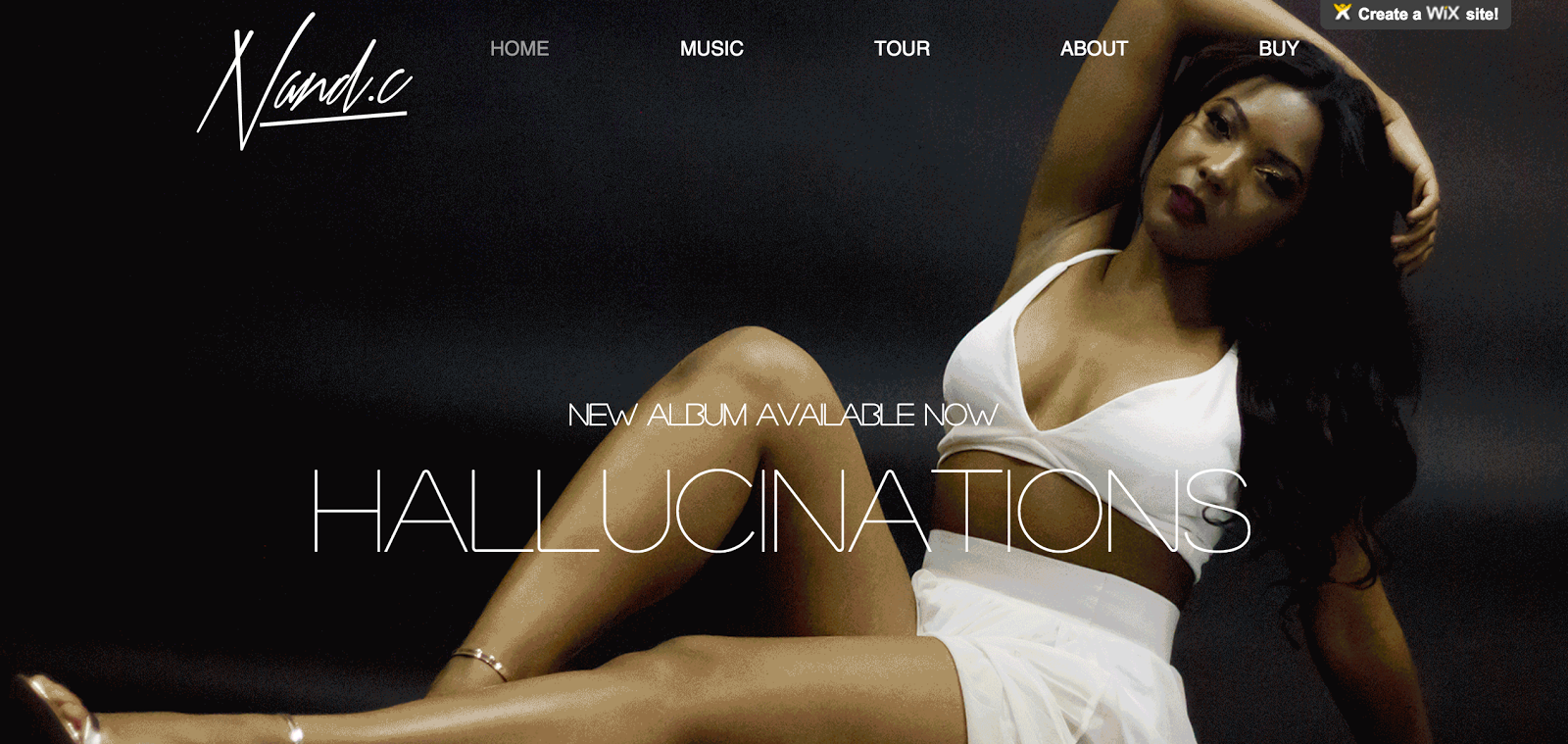
We then also added a light box (image below) that would open across the screen as soon as you entered the website. This would welcome the audience to the website and make them aware of our artist's new album. This would be a quick and easy way to market the album of our artist without the viewer even going through the website.
Even though, we made some changes it was not as difficult to alter our website as it was to alter the editing of our music video or digipak. This is because the oline software we used to create our website 'Wix' was easy to use. Additonally, the website was the last product we created for our music campaign, therefore by this time we had a solid idea and understanding of our artists star image. This made it easier to construct the artists representation on our website.
To create our website we used Wix, a free online software to build our website.
Wix offered us different templates and tools to create our artists website.
The website is an integral part of the music campaign because it offers an interaction between the audience and the artist. The website needed to be engaging, easy to use and visually striking in order to intrigue audiences.
With Wix we were allowed to include social media buttons that would link the website with social media platforms such as Facebook, Twitter and Instagram. We offered concert tickets/tour schedules and also a merchandise page; where fans could buy artist related products.
Screenshots from our website:
We used Adobe Photoshop CC to edit images for the website and most importantly we used it to create the background of the homepage; this was a GIF that changed images of the artist every few seconds.
Below is the construction of the GIF:
For the font of the website we used Marzo, this is because it is a sleek and easy to read font; therefore making it easier for audiences to understand and navigate through the website. For the name of the artist on the website we used the same font as we did on the Digipak, this linked the two products together. It also made it look like our artist’s signature; this made the audience feel closer to the artist. This links in with Dyer’s Star Theory paradox which states an artist ‘must be both ordinary and extraordinary’; which would make the audience feel engaged with the artist and therefore strengthen the fan base.
The purpose and construction of our website is crucial for promoting out artist in an ever-growing online age.