"The camera can capture my face, but until it captures my soul, you ain't got a movie"


Friday, 10 June 2016

Music Campaign: 'Boyz II Men'

A music campaign is an album, a website and a music video that come together and are released to promote an artist or band. I’ll be looking at the group ‘Boyz II Men’ and their latest music video (Losing Sleep), album cover ( for the album 'Collide') and their website which promotes them. 

Boyz II Men are an R&B vocal group, the group tries to combine R&B with classic Motown soul; they are renowned for their ballads and A capella harmonies. 

When Boyz II Men were at their peak in the 1990’s, their target audience was generally young adults and teenagers; appealing more to women because of their songs emotional and romantic nature, additionally women would be more interested in their music because they are usually attracted to the male singers. Boyz II Men are a black male group, they use this as a unique selling point, compared to other boy groups at the time who were white, such as Backstreet Boys and NSYNC. 


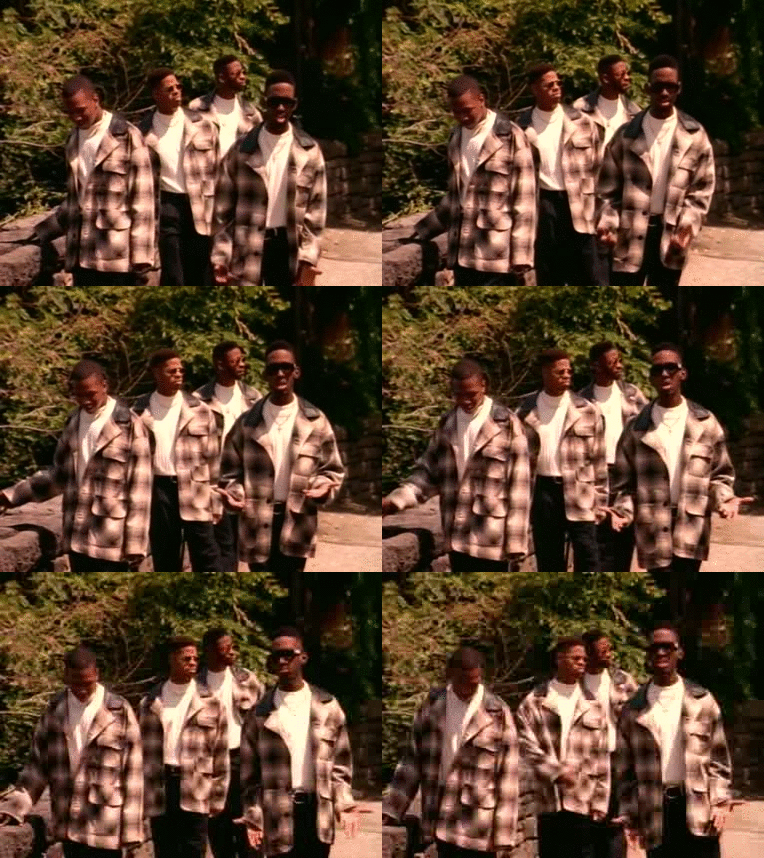
The website, the album cover and the music video all showcase the band together; the trio are all shown together in a line, this links all the products and also emphasises the bands unity. 
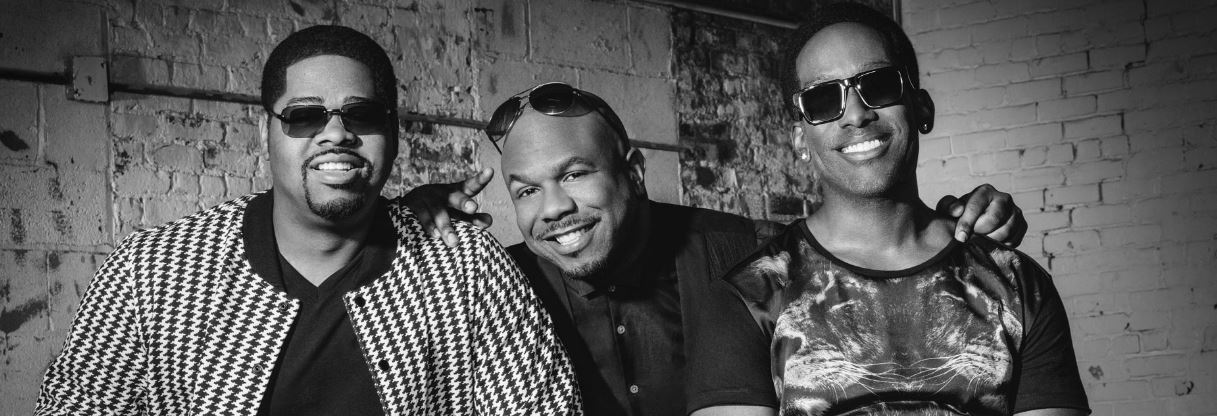
                                         (Website Picture)


                                           (Album Cover)


                                           (Music Video)


There are also similarities across all three products, the band member Nathan Morris wears sunglasses on the album cover, the website photo and in the music video, this cements the singers look and identity within the group. 


Additionally, all three members at some point stand as the lead (in front of the other members), this shows that all members are equal. 


Dyer’s star theory states that for an artist to be successful they need to be original, young, creative and talented. It also  states  that; “the star must be simultaneously present and absent for the consumer" and  “the star must be simultaneously ordinary and extraordinary for the consumer”.  Boyz II Men follow the principles of Dyer’s star theory. For example, they behave and look like ordinary and relatable figures but their fame, accolades and status, make them extraordinary.

 When the group formed they were young, extremely talented and original in their music and style; this fit with the Dyer’s star theory criteria.

 Keith Negus suggested that stars are either organic or synthetic. Artists who are organic, write their own music and are more natural in their image. On the other hand, synthetic artists are constructed and unrealistic figures who are controlled and crafted by the industry. From Negus’s definition because their music videos and photos look staged and fabricated rather than natural artist, 'Boyz II Men' are a synthetic group. The group has also been under contract with big music companies such as Motown and Universal Music; In addition, big recording companies will generally construct synthetic artists as they are more easily marketable and profitable than organic ones.  

There are differences across the three products (website, music video and album cover). Firstly, the website is mainly in black & white and the three singers are presented as being happy, welcoming and approachable. 


However, in their music videos there are bursts of green, red and a heavy use of a blue filter and lighting; their facial expressions are also more sombre and emotional. 


(We see more sad facial expressions and various colours used; such as the blue, green, yellow and red)


The difference in colours from their website and music video may also be because the band want to show different sides to their characters, thus enticing their fans by adding depth to their characters. Additionally, their contrast in facial expressions, having approachable expressions on their website photo allow fans to relate and feel closer to them whilst their distant and emotional expressions in their music video give a more mysterious and ambiguous nature to their character. 


(Website)

                                                                 (Music Video)

This follows the Dyer’s star theory that a star should be, “simultaneously present and absent for the consumer “. 

On the album cover, their faces are looking outwards, and their skin appears to be tattooed and melting away. 


This is a much more dramatic style for them as they are usually known for being simple and less over the top. The reason the album cover may be dramatic and intense in imagery, is because their label may be reshaping their image in order to still please their older fans but also appeal to a younger generation of listeners; therefore their album cover is intended to be visually striking and have a shock value.

In conclusion, I think the campaign was successful in showcasing the groups comeback and also showing their evolution and different facades across the three products. However, it was not one of their best reviewed albums; Andy Kellman of AllMusic said, "This is easily the group's most scattered album, as it offers various shades of ballads, some throwbacks, oddly escapist adult alternative fare, and even anthemic rockers.” The album received a 2 and a half star rating on Allmusic and reached 37 on the Billboard charts. From looking at the statistics and reception I would say it was not financially successful; but it was artistically successful in evolving the groups image and transforming them from ‘Boyz’ to ‘Men’.


Monday, 30 May 2016

My Favourite Music


Beyonce - Me, Myself and I


Mariah Carey - Honey


Michael Jackson - Remember The Time


En Vogue - My Lovin 


Toni Braxton - He Wasn't Man Enough for Me


Introduction to A2

This year on my blog I will have to produce an Advanced Portfolio in Media (which is valued at 100 marks) . This will involve blog post’s documenting our research , a music video, a website for the music video and a Digi-pack.

I will be looking at music videos and the elements used to construct, produce and promote the media product.  Towards the end of the year we will be making a music video, then creating a website for the artist/band and album cover for the artist/band.

From my previous blog, I learnt to record everything that was important in the process and also how I can use different technologies to make my posts more engaging. This is a skill that I will carry on into my A2 year. 

I think that my level of detail in my posts was something that went well , I’m also happy with the vast amount of content and information included on the blog. I think that my previous blog could have used more technologies so that my posts could have been more interesting and interactive. 

I think for this upcoming year, I will have a lot of content to write about, therefore I will hopefully make my blog posts more concise so that I have time to write about everything that occurs in the year. I would like to incorporate new technologies into my blog by presenting my posts in different formats (slideshare, videos etc…). 

Monday, 14 March 2016

Final Post: Our Thriller

This is a clip of our final thriller 'Dammia', a story of a man who digs up his sisters corpse in order to bring her back to life.


Thursday, 18 February 2016

What have you learnt about technologies from the process of constructing this product? (Task 6)

As a group we got together and discussed the technologies we used and have added annotations to our final thriller describing the range of technologies we have used to produce it. 


Overall, my use of technologies in the process of production have improved drastically from the beginning of the project to the final product. At the start of the production I had limited knowledge on handling a camera (e.g. focusing, zooming and moving it around). However I noticed that during the process, different shots that we filmed, required me to perform different camera techniques. With the help of the crew I was able to cement my understanding of the camera. For example, whilst Naomi panned the camera across the dressing table, I twisted the focus lens so that the camera could go in and out of focus, this was to give a disorientated look on camera. 

Another technology I used and improved my use of was the editing software, Adobe Premier Pro. At the start, I did not know how to cut the clips and add layers; I had a limited understanding of how to manipulate the timeline. But as we went through the editing process I learnt how to use cutting tools, trim clips and as far as editing sound and adding titles. 


The cutting tool I used to cut the clips  

I was quite daunted, by the editing task ahead, however I was able to quickly learn new techniques and apply them in editing my final product.


Tuesday, 9 February 2016

How did you attract/address your audience? (Task 5)

Hollywood reporter: We are glad to have Mr.Nabeel in the studio today to discuss his latest film ‘Dammia’ 

Mr.Nabeel: Thank you, it’s a pleasure to be here

Hollywood reporter: My biggest question for you today is how did you attract and address your audience?

Mr.Nabeel: We knew what our audience wanted and we made sure our film fulfilled their needs. Firstly, our plot is an open narrative and open to the audiences interpretation. Our audience would like a plot that they can interpret individually. On top of that, the plot requires the viewer to piece it together and is quiet vague. And lastly, it had all the elements thriller audiences want to see, it is uncomfortable, mysterious and creepy.

Hollywood reporter: So what exact genre is the film?

Mr.Nabeel: The film is a sub-genre of the thriller genre, it is a psychological thriller

Hollywood reporter: What other films have been influential to your film?

Mr.Nabeel: I have always been inspired by Hitchcock, so ‘Psycho’ is a definite inspiration and as well the film ‘Silence of the Lambs’, ‘Love Object’ and the TV show ‘Dexter. Audiences that are fond of these films will also be attracted to our thriller. 

Hollywood Reporter: I just love the setting, but I didn’t really know where it was?

Mr.Nabeel: We set it in a bedroom in a boarding house. We chose this location because, the audience would relate with the setting of a girls bedroom, therefore making them feel uncomfortable. I think the audience will respond well to it, because it is a real and recognisable setting, thus the audience will invest time in the plot and character; putting them on edge due to their emotional connection to the film.

Hollywood reporter: It’s amazing how much work it goes in choosing and setting a location. Can you tell us more about your plot line?

Mr.Nabeel: It is about a girl getting ready, until it is revealed at the end that she was being dressed and made-up by a grown man. 

Hollywood Reporter: That sounds so interesting and creepy, but how will this attract your audience?

Mr.Nabeel: The make-up sequence is visually attracting, the reds and pinks against her white skin. The visual elements create soft and delicate images that get interrupted by the overall tense and dark atmosphere. The audience is pulled further in and shocked when it is revealed that the man was doing it all. It sustains the tension until the end when there is a sudden reveal.

Hollywood reporter: And how would this address what your audience is expecting?

Mr.Nabeel: We are approaching this film simplistically with a thriller approach. Our plotline and editing techniques create a vague and intense plot, which the audience needs to deduce, interpret and put together- It is not patronising, like most thrillers out there. This makes the film very engaging with the audience, satisfying their needs for a thriller audience.

Hollywood Reporter: Now that we know about the plot, tell us about the characters, what kind of characters are they and will your audience like them or not?

Mr.Nabeel: Well the main character is the ‘Psychopathic Man’ he is very complex and I think the audience might fear him or be intimidated but will be very interested in his psyche and why he does what he does. There are many supporting characters, the girl is dead from the start and the audience might empathise with her because she is very vulnerable to the man. However, her purpose is to be a tool to engage us with the male character.

Hollywood Reporter: And to what social groups would your film appeal to?

Mr.Nabeel:  We are targeting a male audience of 40+, that is our target audience. We did this by creating a complex narrative which would need a mature and experienced audience with a critical thinking ability to understand the plot and themes of the film. The plot could be too complex for a younger audience. 

Hollywood Reporter: So the soundtrack you used in the beginning, could you tell us more about that?

Mr.Nabeel: We used a non-diegetic soundtrack, it is a soft jazz piece, its slow tempo synchronises with the rhythmic and slow pace of the sequence. It is also contrapuntal to the images on screen, therefore making the viewer feeling uncomfortable, because the music does not fit with the atmosphere of the sequence. The increase in tempo in the music builds the tension as there are more clues revealed that she is not putting on the make-up herself. The name of the soundtrack is 
 “It Hurts to Say Goodbye”, which ironically, fits with the plot line because the ‘Man’ cannot say goodbye to his dead sister.

Hollywood Reporter: You had some interesting people in your titles during the opening sequence, what information did you give and why?

Mr.Nabeel: Well, I followed the general conventions and rules of the industry and placed the directors name first, then studio, then production companies then actors and crew last. Because the film is so confusing, I wanted the audience when reading the title sequence to at least know the basic information of the people in and behind the film, I didn’t want it all to be vague, that’s why the titles are clear and simple. 

Hollywood Reporter: What clues might the credits give your target audience?

Mr.Nabeel: We had new actors and directors that the audience would not know, and would be interested in discovering, for a lot of these actors it was their debut role.

Hollywood Reporter: What editing techniques and style were you going for and how would this attract your audience?

Mr.Nabeel: We wanted to have a basic rhythm throughout the sequence. We used a technique where would count ‘1,2,3’ and then cut, ‘1,2,3’ and then cut. This made the sequence have a consisted pace which balanced the shocking and tense images on screen. The cuts in between transitions were as smooth as possible and also when we cut on action, this was to create a fluid and easy to watch sequence. We did not want to use complicated transitions and effects because we wanted to have the piece as simplistic as possible so that the audience could focus on the plot and detail of the images. The simplistic and raw editing used would also be appreciated by an older audience who are generally not fans of special effects, and computer graphics. We wanted to bring it back to basics. 

Hollywood Reporter: Well that’s perfect, I think that’s all we need, thank you so much for your time. I can’t wait to see it. ‘Dammia’ is out this summer, June 16th, at all your local cinemas.

Mr.Nabeel: Thank you.